The Hidden Costs of Alts: Your Inbox Is About to Grow 5x
By Ryan Eisenman, co-founder and CEO, Arch
Private markets are no longer a niche investment. They're becoming a core allocation, and registered investment advisors (RIAs) who don't plan for the operational side are about to find out what that means. It starts in the inbox.
From 3% to 20%: the allocation shift is already underway
Today, individual investors hold roughly 3% of their portfolios in private investments, compared with about 23% for institutions, according to Fidelity. That gap is closing fast. In a CAIS and Mercer survey of nearly 800 US advisors, 88% said they plan to increase client allocations to alternatives over the next two years. Advisors also have a target in mind: in a Blackstone survey of advisors across the US, Europe and Asia, more than 40% recommend that clients hold 10–20% in private markets.
For advisors, that's good news: more diversification, more differentiated client outcomes, and a stronger value proposition. But every new private markets position comes with something public equities don't: a steady stream of paperwork.
The math behind the paperwork
- The average private markets investment sends 13 documents a year. (1)
- The top decile sends 25 or more. (1)
Averages only tell part of the story. Some positions send just one or two documents a year, but nearly 12%, the largest single group, sends 25 or more. A handful of heavy positions can add far more to your team’s workload than the average suggests.
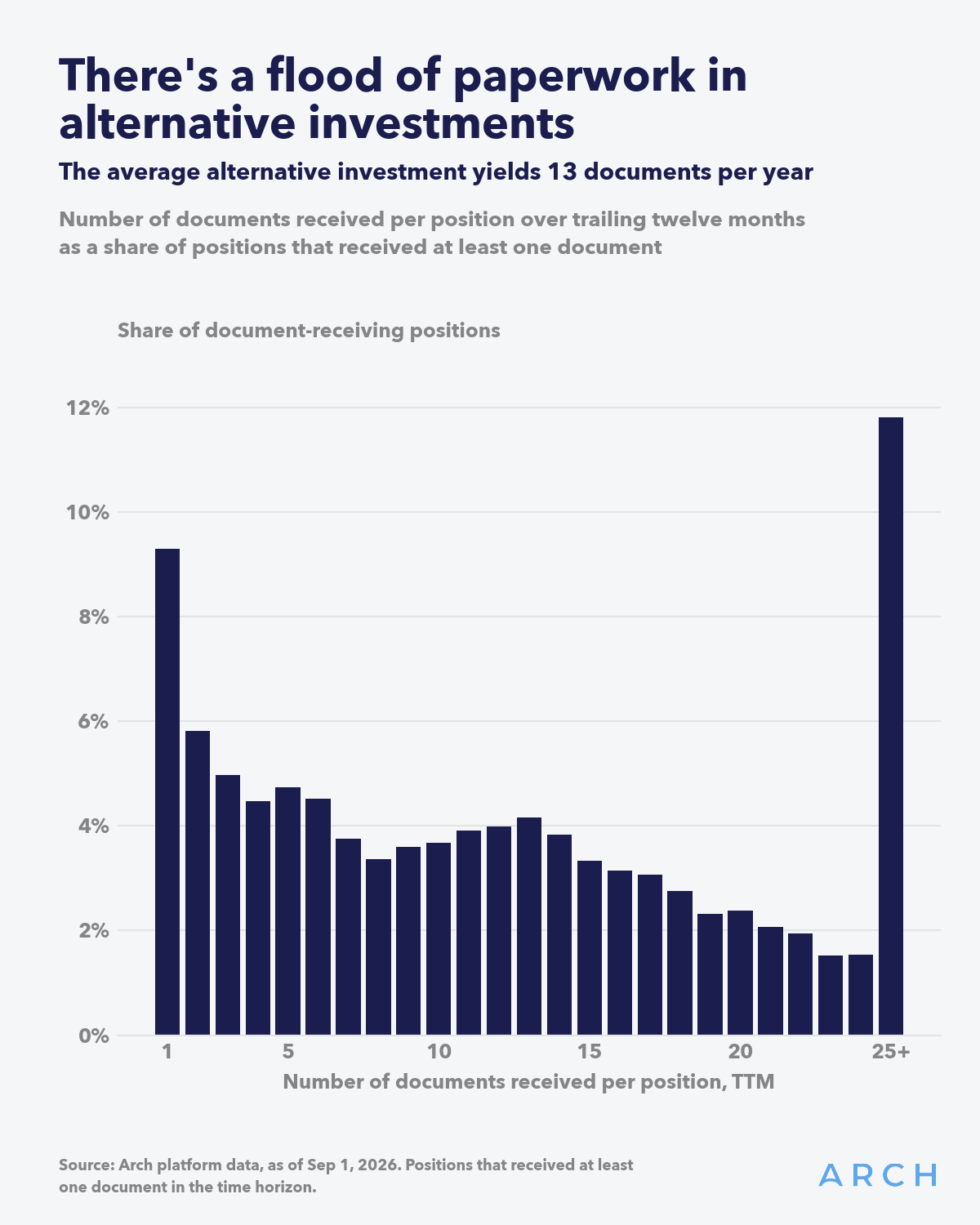
Now scale that across a client's portfolio: At 19 investments, that's roughly one document for every business day of the year, for a single client. If you hold top-decile funds and you hit that mark at just 10 investments.
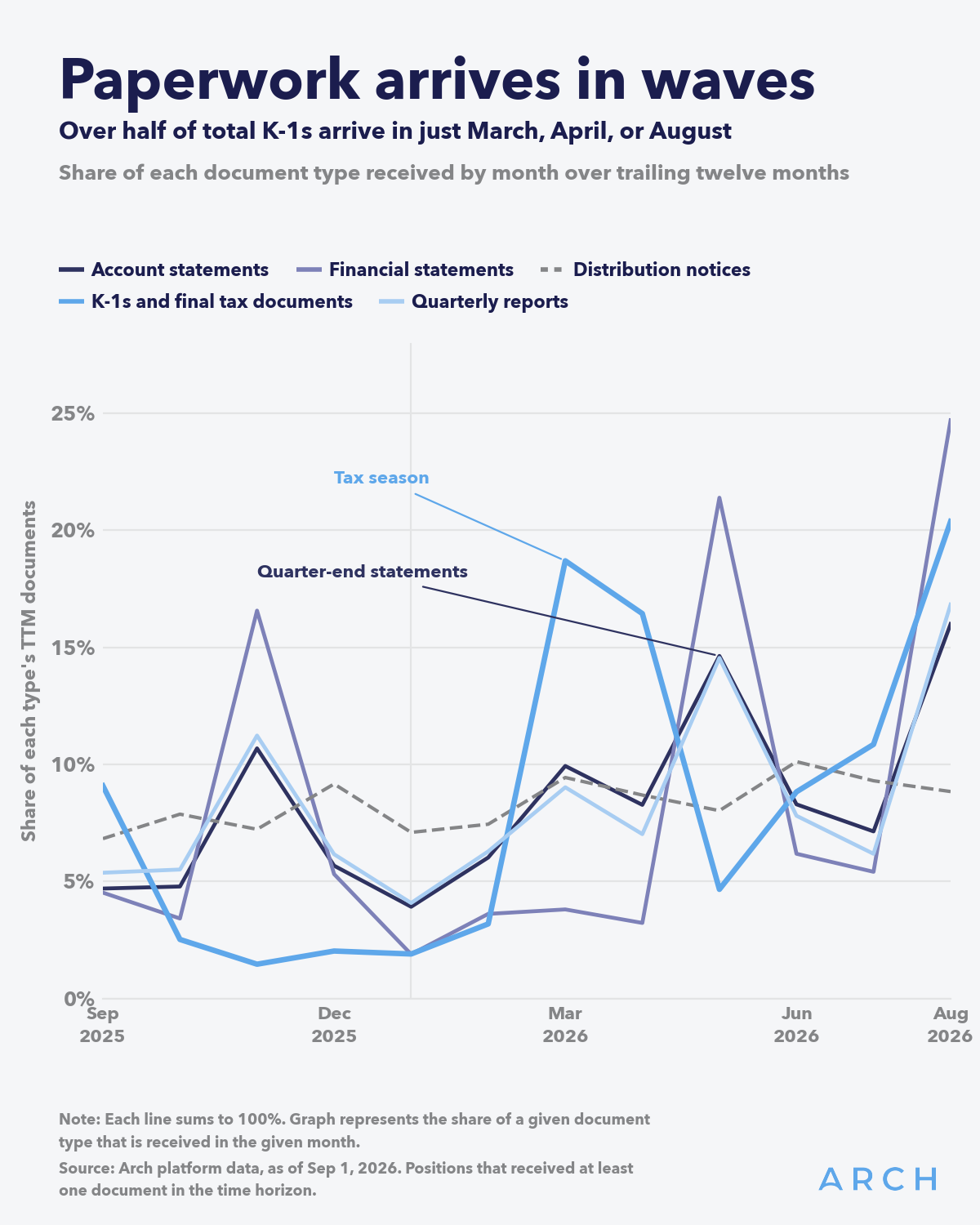
Documents don't arrive evenly. They arrive in waves.
If alts paperwork trickled in at one document a day, it would be manageable. It doesn't.
GPs report on a quarterly cycle, and statements typically land weeks after quarter end. That creates four predictable floods:
- March: year-end reporting, colliding with K-1 season and tax deadlines
- May: Q1 reporting
- August: Q2 reporting
- November: Q3 reporting
Between those windows, it's quieter. During them, your operations team or client service associates are buried.
This pattern shows up clearly in the data. The chart below tracks when each type of document arrives over the past twelve months. Quarter-end statements spike a few weeks after each quarter closes, and K-1s and other tax documents pile up in the spring and again in late summer. Over half of all K-1s arrive in just three months.
What this looks like across a typical investment advisor
Take an RIA with 100 clients who each hold 4 private investments today, roughly in line with a ~3% allocation. That's 400 positions and about 5,200 documents a year.
Now move those clients toward a 15% allocation, about 5x where they are today. Positions grow to roughly 2,000, and annual documents climb to about 26,000.
If just half of those arrive during the four reporting waves (about 15 business days each), your team is looking at 200+ documents per business day at peak. Each one needs to be downloaded from a GP portal, identified, filed to the right client and entity, read, and keyed into your reporting and tax workflows.
That's the hidden cost of alts. It doesn't show up in the fee schedule. It shows up in:
- Headcount: operations hires added just to keep pace with portals and PDFs
- Delays: stale valuations and late performance reporting while the backlog clears
- Errors: manual data entry mistakes that reach client reports
- Missed deadlines: capital calls and K-1s that slip through during peak season
- Advisor time: hours spent chasing documents instead of advising clients
Without infrastructure, tax-season waves don't just become stressful. They become unmanageable.
How Arch helps RIAs scale private markets without scaling headcount
Arch is built for exactly this problem. Instead of adding people or sacrificing service every time allocations grow, RIAs use Arch to turn the document flood into trusted, usable data.
1. Automate document collection
Arch connects to GP and fund administrator portals and automatically collects capital calls, distributions, statements, K-1s, and more. No more logging into dozens of portals at quarter end.
2. Route the right information to the right people
Documents are identified, organized by client, entity, and investment, and routed to the people who need them: operations, tax, advisors, and clients. Capital calls get flagged before deadlines. K-1s reach CPAs on time.
3. Turn trusted data into portfolio insights
Because Arch extracts and checks the data inside every document, your private markets holdings become as reportable as your public ones. Advisors use that trusted data to surface portfolio opportunities, track performance and liquidity, and have better conversations with clients.
The bottom line
The shift to private markets is one of the biggest opportunities in wealth management, and one of the biggest operational tests. The RIAs that win won't be the ones that hire fastest. They'll be the ones that build the infrastructure first.
See how Arch automates alternative investment operations. Book a demo.
Frequently asked questions
How many documents does a private investment generate each year?
The average private markets investment sends about 13 documents per year, including capital call notices, distribution notices, quarterly statements, and K-1s. Top-decile investments send 25 or more. (1)
When do private fund documents typically arrive?
Most arrive in waves after quarter end, concentrated around May, August, November, and March. March combines year-end reporting with the start of K-1 season. (1)
Why is alternative investment reporting harder than public markets reporting?
Public holdings flow through custodial data feeds. Private investments communicate mostly through PDFs on individual GP portals, which must be collected, read, and entered manually without automation.
How can RIAs manage growing alternative investment allocations?
By automating document collection and data extraction. Platforms like Arch collect documents from GP portals, route them to the right teams, and convert them into structured data for reporting and analysis.
Source: (1) Arch platform data, September 2025 through August 2026, as of September 1, 2026. Values shown include total fund documents received in fund-to-investor mail over trailing twelve months for positions that received at least 1 document, covering a sample of 12,800 fund managers. Excludes platform test/demo accounts, archived records, revisions, and historical backfills. No individual client or fund data is identifiable.